 StudyMina
How Many Flashcards Should You Study Every Day?
There is no magic number, but there is a sensible way to set one. Learn how to size your daily flashcard reviews and new cards so you can sustain them.

In this article
- Why there is no universal number
- The two numbers that matter
- A practical method to set your number
- Quality beats quantity
- Adjust by situation
- What a sustainable daily session looks like
- Signs you are doing too many
- Signs you are doing too few
- The short answer
- The easiest way to keep your daily flashcards on track: StudyMina
- Sources
Search for this question and you will find confident answers: 20 new cards a day, 50, 100. They are guesses. The honest answer is that the right number depends on your time, your material and how fast you forget. What matters more than the number is how you choose it, and how you keep it from growing into a pile of reviews you can no longer finish. This guide gives you a method.
Why there is no universal number
The number of cards you can handle depends on:
- Time available. Twenty minutes a day supports far fewer cards than an hour.
- Card difficulty. A card you answer in three seconds is cheaper than one that needs a minute of thought.
- Your retention. If you forget many cards, you will see them more often.
- Your goal and deadline. An exam in three weeks needs a different pace from a qualification over two years.
Research on the spacing effect, such as the 2006 review by Cepeda and colleagues, shows that the ideal gaps between reviews depend on how long you need to remember. So a fixed daily quota cannot be right for everyone.
The two numbers that matter
Every day you have two kinds of work: new cards (learning) and reviews (cards you have already seen). Reviews pile up, so it is the new-card rate that you control.
A rough rule of thumb used by many spaced-repetition users is that each new card you add will need to be reviewed many times over the following weeks, so a steady stream of new cards eventually produces a daily review load that is a multiple of your new-card rate. The exact multiple varies, which is why you should measure it instead of trusting a formula.
A practical method to set your number
- Decide your daily time budget, for example 20 minutes.
- Start low: 10 new cards a day.
- Track how long your reviews take for a week.
- Adjust. If you finish comfortably and your accuracy is good, add a few new cards. If reviews are taking longer than your budget, cut new cards.
- Protect reviews first. Never skip reviews to add new cards. Overdue reviews are how piles become unmanageable.
The general principle is to set the new-card rate so that your total daily work fits your time budget on a normal day, with some slack for a bad one.
Quality beats quantity
A smaller set of well-made cards beats a huge sloppy deck. Signs that your cards are costing more than they give:
- Cards with several facts. Split them, or the card is unmarkable.
- Cards you never get right. They are probably badly worded or need understanding first, not repetition.
- Cards for things you already know. Delete them.
- Cards copied without understanding. If you cannot explain the idea, learn it before making a card. See how to create flashcards from lecture notes using AI for a way to check cards before you commit to them.
Adjust by situation
Before an exam in a few weeks: prioritise the highest-value topics, add cards for the most examinable material, and accept that you will not turn every note into a card. Use shorter gaps between reviews.
Across a semester: add cards after each lecture, in small batches, and keep a steady review habit. Long-term retention gets the most from regular, spaced reviews, as described in our guide to spaced repetition.
During a busy week: reduce or pause new cards, but keep doing reviews. Even a few minutes keeps the pile from growing.
Returning after a break: do not try to clear a huge backlog in one day. Spread it over several days, or reset the oldest cards.
What a sustainable daily session looks like
- Five to ten minutes after each lecture to make or review a few cards.
- One focused review session of 15 to 30 minutes at a regular time.
- Answering from memory before flipping, every time. The retrieval is the point, as covered in our article on active recall.
- A weekly check-in to delete weak cards and plan the next week's additions.
Signs you are doing too many
- Your review sessions regularly take longer than planned.
- You rush and flip cards without trying to recall.
- The backlog grows week after week.
- You dread opening the app.
If this sounds familiar, cut your new cards by half and clear the backlog gradually.
Signs you are doing too few
- You finish easily and rarely get a card wrong.
- Your deck is not growing even though you have material left to cover.
- Exams are approaching and key topics lack cards.
Add a few cards at a time and watch how your review load responds.
The short answer
Start with a small number, such as 10 new cards a day, protect your reviews, and adjust once a week based on how long your sessions take and how many cards you get right. The right number is the largest one you can keep up for months.
The easiest way to keep your daily flashcards on track: StudyMina
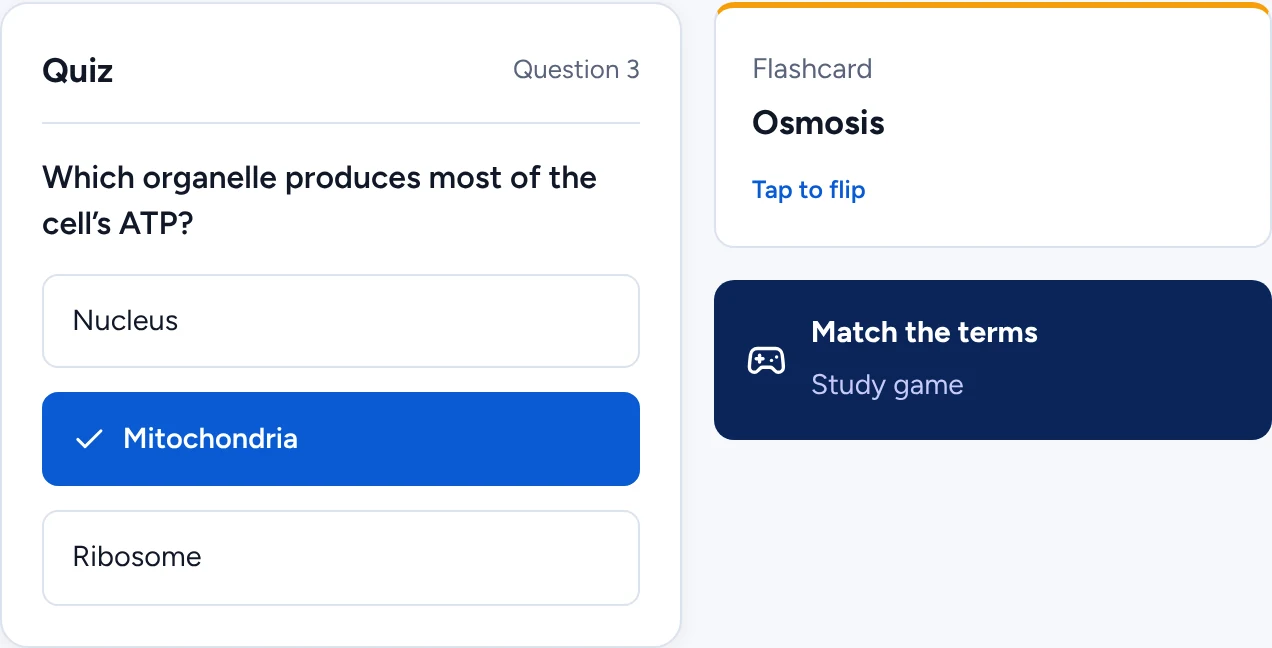
Plan a fixed daily review session in StudyMina’s planner, and generate flashcards from your notes in small batches so your deck grows at a pace you can sustain.
Sources
- Cepeda, N. J., Pashler, H., Vul, E., Wixted, J. T., & Rohrer, D. (2006). Distributed practice in verbal recall tasks. Psychological Bulletin, 132(3), 354–380. doi.org/10.1037/0033-2909.132.3.354
- Roediger, H. L., & Karpicke, J. D. (2006). Test-enhanced learning. Psychological Science, 17(3), 249–255. doi.org/10.1111/j.1467-9280.2006.01693.x