 StudyMina
How to Prepare a 30-Day Examination Study Plan
A week-by-week method for planning the last 30 days before an exam, with a sample calendar, time-allocation rules and what to do when you fall behind.
In this article
Thirty days is enough time to make a real difference to an exam result, but only if you use it deliberately. Students who have a month tend to waste the first two weeks on "getting organised" and then panic in the last three days. This guide gives you a four-week structure you can adapt to any exam, whether it is a university paper, a professional qualification or an international test.
The principle: work backwards, test early
A 30-day plan has three phases, and the order matters:
- Diagnose (days 1 to 3): find out what you actually know and what the exam really asks.
- Build (days 4 to 22): close gaps topic by topic, with regular recall practice.
- Rehearse (days 23 to 30): exam conditions, mixed practice, light review and rest.
Most students invert this. They spend weeks rereading notes and only attempt practice questions at the end, when it is too late to act on what the questions reveal. Research on learning consistently favours the opposite: testing yourself early and spreading your review over time. Our guides on active recall and spaced repetition explain the evidence.
Days 1 to 3: Diagnose
Before you plan anything, gather three things.
The syllabus or topic list. Write every examinable topic on one page. If your course has a syllabus document, use that, not your memory of what the lecturer emphasised.
The exam format. How long is the paper? How many questions? Are they multiple choice, short answer, essays, problem-solving or a mix? Is it open book? Check with your lecturer, exam board or the official exam provider. Never rely on rumour.
A baseline. Do a short, closed-book attempt at past questions or practice questions from every major topic. Do not worry about the score. The goal is to sort topics into three groups:
- Red: you cannot answer them or do not recognise them.
- Amber: you get some right but are unsure.
- Green: you answer them confidently.
This sorting is the most valuable hour of the whole month, because it tells you where to spend your time.
Days 4 to 22: Build
Allocate time by colour, not by topic order
A common mistake is to study topics in the order they appear in the syllabus. Instead, give red topics the most time, amber topics some, and green topics a short, regular refresh. A rough split of study time might be 50% red, 35% amber and 15% green, though the exact numbers are not important. The principle is that confident topics should not take half your time just because they feel pleasant.
Use a repeating weekly pattern
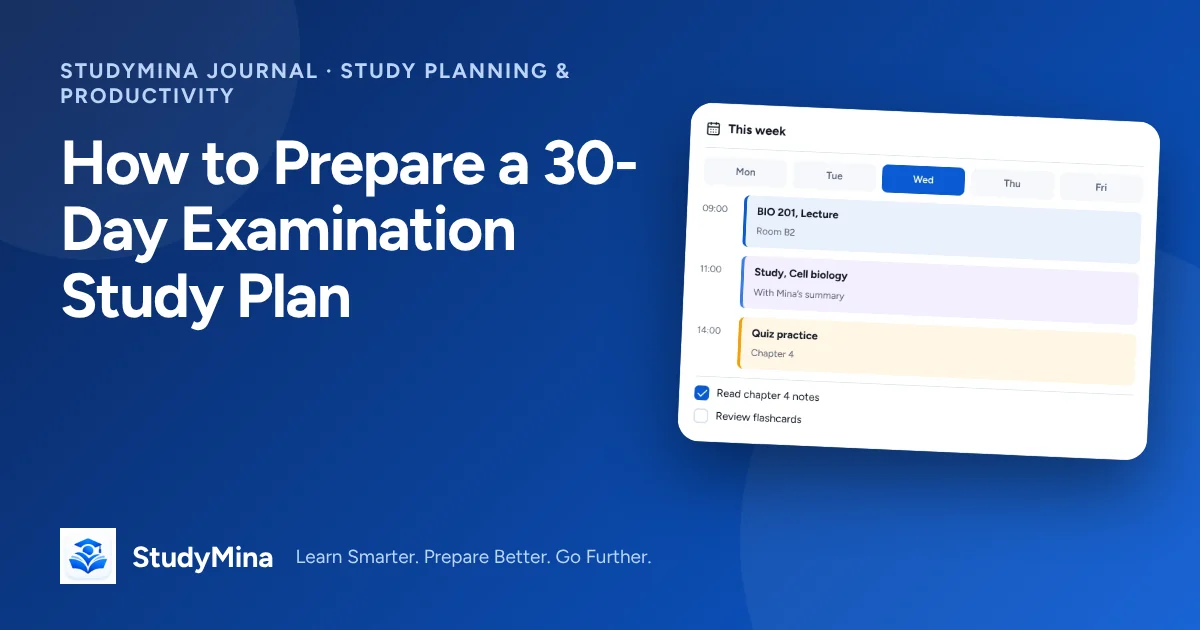
A repeating pattern is easier to follow than a unique plan for every day. For example:
| Day | Focus |
|---|---|
| Monday to Thursday | Two topic sessions per day (red first, while your energy is highest), plus a short recall review of earlier topics |
| Friday | Practice questions mixed across the week's topics |
| Saturday | A longer practice session or a timed paper section, then error review |
| Sunday | Light review, plan next week, rest |
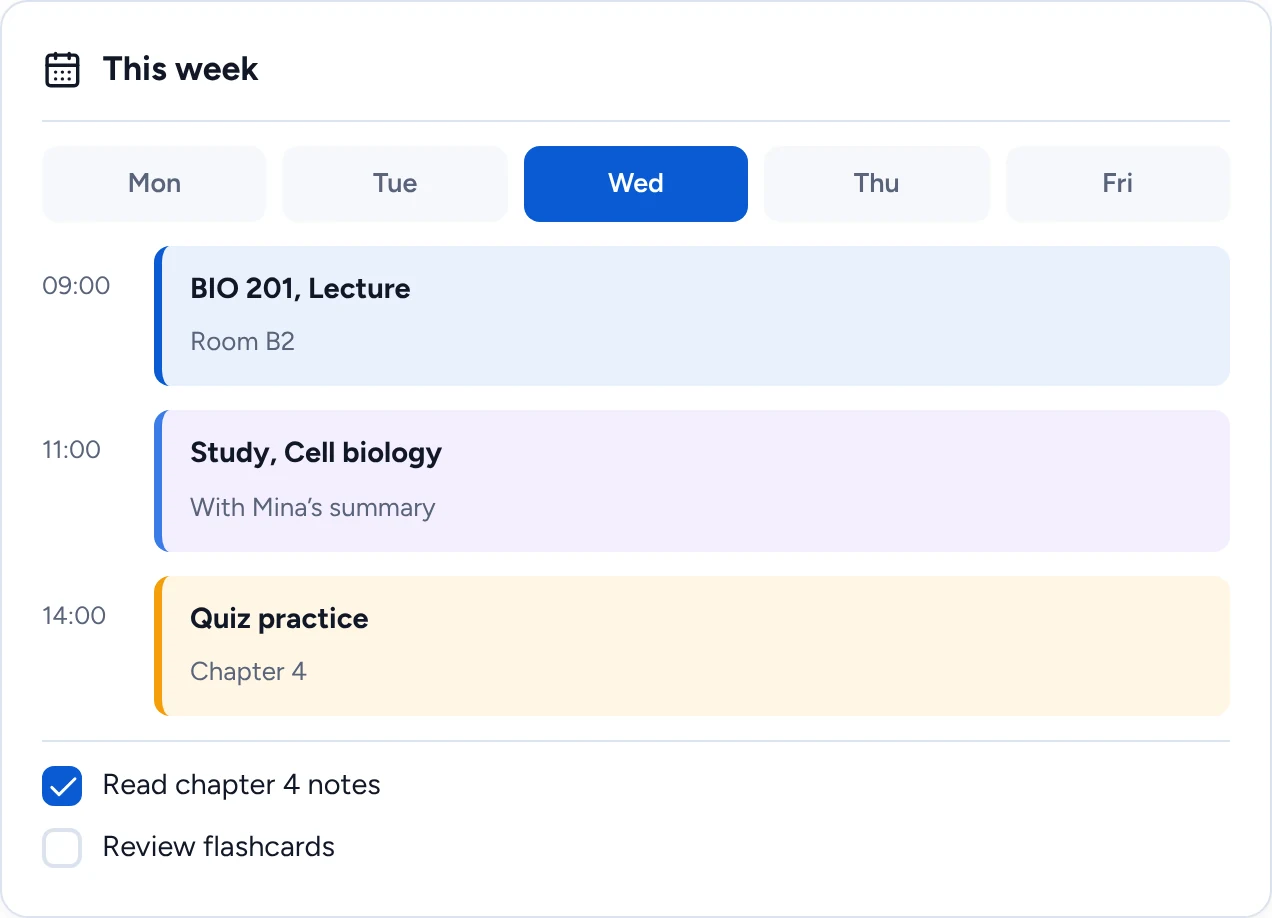
Our guide to creating a weekly study timetable shows how to fit this around lectures, work and family.
Make every session end with recall
For each topic, finish by closing your notes and writing down what you remember, or answering a few questions. Then check. This is far more effective than rereading. Revisit each topic after one to two days, again after about a week, and again near the end. That is spaced repetition in practice.
Keep an error log
Every mistake goes in one place with its cause: did you forget a fact, misread the question, make a calculation slip, or not understand the concept? Review the log every few days. Patterns appear quickly, and they tell you what to fix.
Days 23 to 30: Rehearse
The final week is not for learning large new topics. It is for performance.
- Do full timed practice under exam conditions: same time limit, no notes, no phone.
- Review your error log and redo questions you got wrong.
- Mix topics so you practise switching between them, as the exam will.
- Taper. In the last two days, do light review only. Sleep matters more than another late-night session.
- Prepare logistics: know the venue, bring what is allowed, plan your journey, and check your registration details.
A sample 30-day calendar
This is an illustration for a student with a fairly typical load.
| Days | Phase | Main activities |
|---|---|---|
| 1 to 3 | Diagnose | Topic list, exam format, baseline questions, red/amber/green sort |
| 4 to 10 | Build 1 | Red topics first, recall at the end of each session, start the error log |
| 11 to 17 | Build 2 | Remaining red and amber topics, first timed section, review earlier topics |
| 18 to 22 | Build 3 | Amber topics, green refresh, mixed practice sets |
| 23 to 27 | Rehearse | Full timed papers, error review, targeted fixes |
| 28 to 29 | Taper | Light review of the error log and key formulas or facts |
| 30 | Rest | Short review only, early night |
What if you only have 30 days and a lot to cover?
Be honest about triage. If you cannot cover everything:
- Prioritise by marks. If a topic is worth a large share of the paper, it comes first.
- Drop perfectionism on green topics. Do not polish what you already know.
- Prefer breadth to depth in amber areas. Getting from half-understood to adequate is worth more than getting from adequate to excellent.
- Do not skip practice. Practice questions find gaps faster than rereading.
What to do when you fall behind
You will miss days. A plan that cannot absorb that is not a plan.
- Build one buffer day per week and use it to catch up.
- If you fall more than two days behind, cut the least important topic instead of cramming everything.
- Never skip the recall step to "save time". It is where the learning happens.
- If you are consistently behind, your plan is too heavy. Reduce it by a third.
Tools
Paper, a spreadsheet or a calendar app all work. A study app that keeps planning and practice together can save effort. StudyMina, for example, lets you plan your sessions and generate practice questions from your own notes in the same place. Whatever you use, choose the tool you will open every day.
The best way to run your 30-day plan: StudyMina
Put your 30 days into StudyMina’s planner, schedule each topic session and practice day, and generate quizzes and flashcards from your own notes for the recall step. StudyMina also supports preparation for international exams such as IELTS, TOEFL, SAT, ACT, GRE and GMAT.
Sources
- Roediger, H. L., & Karpicke, J. D. (2006). Test-enhanced learning. Psychological Science, 17(3), 249–255. doi.org/10.1111/j.1467-9280.2006.01693.x
- Cepeda, N. J., Pashler, H., Vul, E., Wixted, J. T., & Rohrer, D. (2006). Distributed practice in verbal recall tasks. Psychological Bulletin, 132(3), 354–380. doi.org/10.1037/0033-2909.132.3.354
- Dunlosky, J., Rawson, K. A., Marsh, E. J., Nathan, M. J., & Willingham, D. T. (2013). Improving students’ learning with effective learning techniques. Psychological Science in the Public Interest, 14(1), 4–58. doi.org/10.1177/1529100612453266