 StudyMina
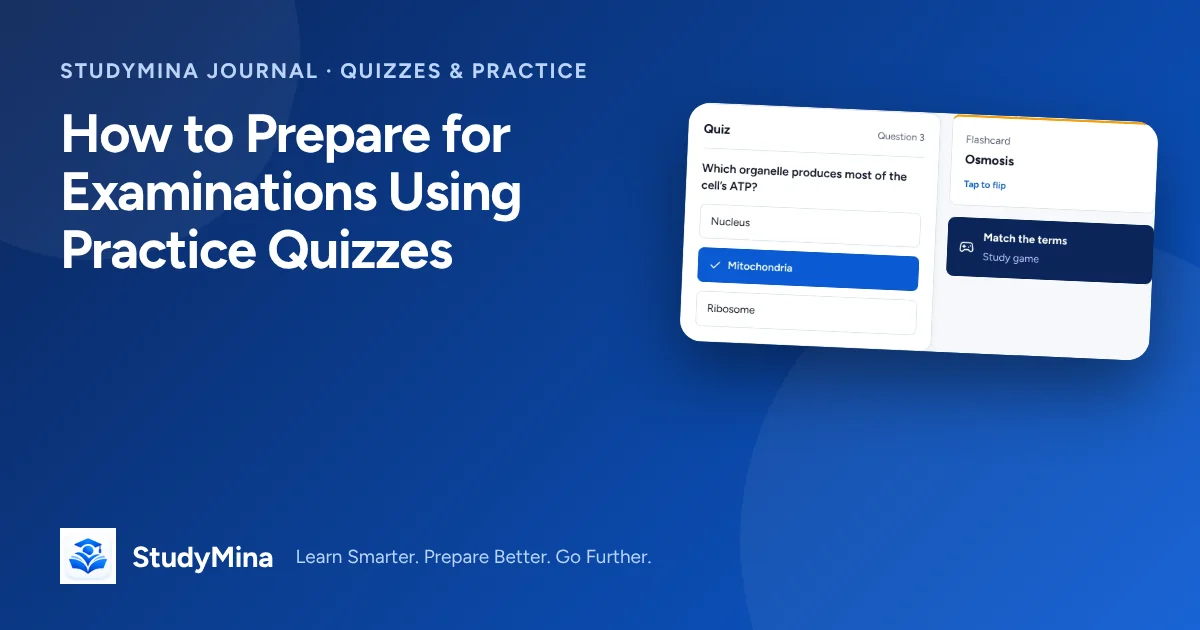
How to Prepare for Examinations Using Practice Quizzes
A step-by-step system for using practice quizzes to prepare for exams: how often to quiz, how to review mistakes and how to move from topic quizzes to full mock exams.
In this article
- The best place to make your practice quizzes: StudyMina
- The quiz cycle
- Phase 1: Topic quizzes (early)
- Phase 2: Mixed quizzes (middle)
- Phase 3: Timed mock exams (late)
- Where to get questions
- How to review mistakes
- How often should you quiz?
- Common mistakes
- A one-week example
- Make your practice quizzes in StudyMina
- Sources
Quizzes are the closest thing most students have to a free preview of the exam. Used well, they show you what you do not know while you can still fix it, and they strengthen what you do know. Used badly, they become a way to feel productive. This guide shows how to build practice quizzes into your exam preparation so that every attempt teaches you something.
The best place to make your practice quizzes: StudyMina
When you answer a question, you retrieve information from memory instead of simply recognising it on a page. Roediger and Karpicke's 2006 study found that students who took memory tests remembered substantially more after two days and a week than students who restudied the material, even though the restudy group felt more confident. In a 2013 review, Dunlosky and colleagues rated practice testing as one of the most useful study techniques. Our guide to active recall explains the evidence.
Quizzes also give you feedback. A wrong answer is a precise signal about what to study next.
The quiz cycle
Think of each quiz as a four-step loop:
- Attempt the questions from memory, without notes.
- Mark honestly, counting vague answers as wrong.
- Diagnose each mistake: forgot, misunderstood, misread, or slipped.
- Fix and retest after a day or two.
Most students do step 1 and a rushed version of step 2. The learning is in steps 3 and 4.
Phase 1: Topic quizzes (early)
Start with short quizzes on one topic at a time, about 5 to 15 questions. Do them soon after you study a topic, then again a few days later. At this stage the goal is to find gaps, not to achieve a score.
- Take the quiz before you feel ready. Struggling is useful.
- Use mixed question types: definitions, explanations and applications, not only recall.
- Record every mistake in an error log with its cause.
Phase 2: Mixed quizzes (middle)
Once you have covered several topics, combine them. A real exam does not arrive in chapter order, and being able to switch between topics is a skill.
- Draw questions from different topics in one session.
- Include older topics to check you have not forgotten them. This is spaced practice, which Cepeda and colleagues' 2006 review found to be effective for long-term retention. See spaced repetition.
- Focus extra attention on topics where you keep missing questions.
Phase 3: Timed mock exams (late)
In the last weeks, move to full-length practice under exam conditions.
- Match the real format: length, question types, marking if you know it.
- Time yourself and practise pacing. Decide how long to give each question.
- Remove aids: no notes, no phone, no pausing.
- Review thoroughly afterwards. Spend at least as long reviewing a mock as taking it.
Our 30-day exam study plan shows where these phases fit in a month.
Where to get questions
- Official past papers from your exam board or university are the best guide to real style and difficulty.
- Textbook questions and end-of-chapter problems.
- Lecturer-provided questions and tutorial sheets.
- Self-written questions. Writing questions from your notes teaches you what matters.
- AI-generated questions from your own notes, which can be quick to produce but need checking. See how to generate practice questions from PDF notes.
A caution about AI-generated questions: they are practice material, not official past exam questions, and they can contain errors. Verify them against your notes, and use official papers to calibrate to the real exam.
How to review mistakes
The error log is the most valuable thing your quizzes produce. For each wrong answer, note:
- the topic,
- what you answered and what was correct,
- the cause, such as knowledge gap, misread question, calculation slip or ran out of time,
- the fix: reread, practise more, or learn a technique.
Review the log before each new quiz session. After a few weeks you will see patterns, such as always losing marks on units, or always misreading "which of the following is not". Patterns are fixable once you can see them.
How often should you quiz?
There is no perfect schedule, but a good rule is little and often. Short quizzes after each study session, a mixed quiz once or twice a week, and full mocks in the final stretch is a pattern most students can sustain. Do not leave quizzing until the last week.
Common mistakes
- Looking at the answer too soon. Commit to an answer first.
- Quizzing only on what you already know. Comfortable quizzes feel good but teach little.
- Not reviewing mistakes. A quiz without review is just a score.
- Memorising the questions. If you recognise the answer from earlier attempts, you are testing recognition, not understanding. Mix in fresh questions.
- Ignoring timing. Knowing the content but running out of time is a common way to lose marks.
A one-week example
| Day | Quiz activity |
|---|---|
| Monday | 10-question quiz on Topic A, review mistakes |
| Tuesday | 10-question quiz on Topic B, retest 3 questions from Topic A |
| Wednesday | Rest or light review |
| Thursday | Mixed 20-question quiz across A, B and an older topic |
| Friday | Redo all questions in the error log |
| Saturday | Timed section of a past paper, full review |
| Sunday | Plan next week based on your error log |
Adjust it to your timetable. The shape matters more than the details.
Make your practice quizzes in StudyMina
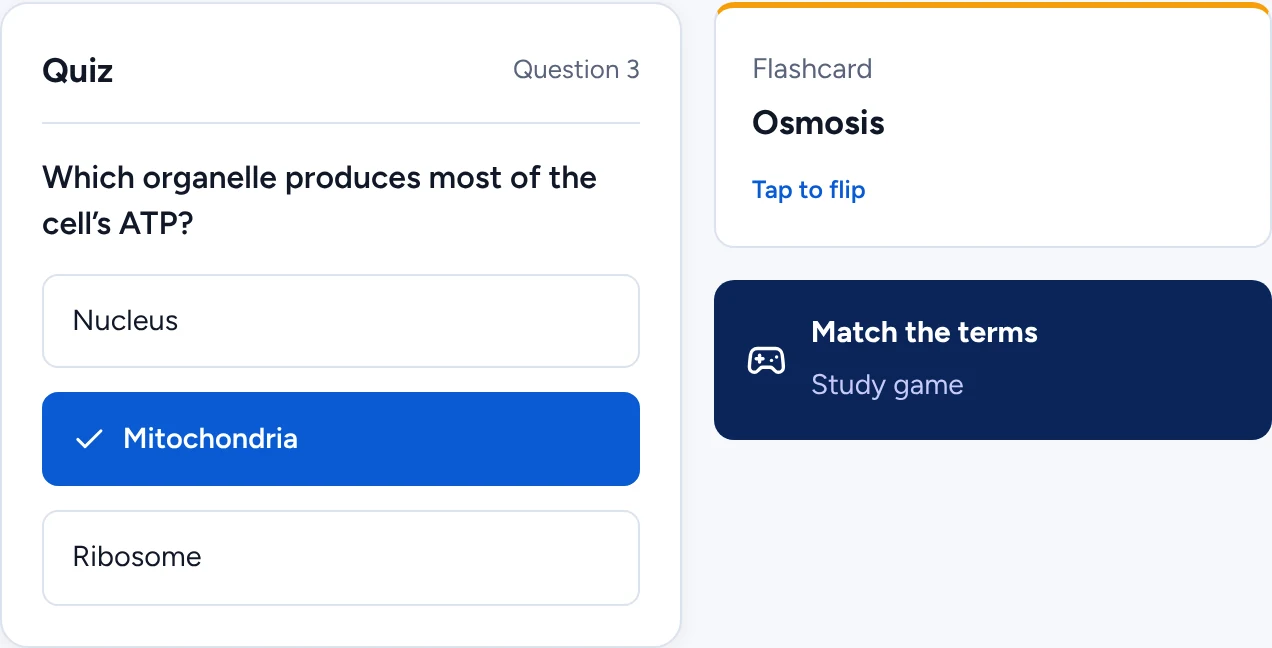
StudyMina can generate quizzes and practice questions from your own notes and PDFs, and it keeps flashcards, a planner and Mina in the same app, so you can quiz, find a weak topic, get an explanation and schedule a retest in one place.
Sources
- Roediger, H. L., & Karpicke, J. D. (2006). Test-enhanced learning. Psychological Science, 17(3), 249–255. doi.org/10.1111/j.1467-9280.2006.01693.x
- Cepeda, N. J., Pashler, H., Vul, E., Wixted, J. T., & Rohrer, D. (2006). Distributed practice in verbal recall tasks. Psychological Bulletin, 132(3), 354–380. doi.org/10.1037/0033-2909.132.3.354
- Dunlosky, J., Rawson, K. A., Marsh, E. J., Nathan, M. J., & Willingham, D. T. (2013). Improving students’ learning with effective learning techniques. Psychological Science in the Public Interest, 14(1), 4–58. doi.org/10.1177/1529100612453266