 StudyMina
How to Stop Procrastinating and Start Studying
Why students procrastinate and what actually helps: shrink the first step, make if-then plans, remove friction and fix the causes behind avoidance.
In this article
- What procrastination actually is
- Start by finding your reason
- Strategy 1: Shrink the first step
- Strategy 2: Use if-then plans
- Strategy 3: Create nearer deadlines
- Strategy 4: Make the environment do the work
- Strategy 5: Work in short, defined blocks
- Strategy 6: Lower the bar on quality
- Strategy 7: Be kind to yourself when you slip
- A simple routine to try this week
- When procrastination is a bigger problem
- The best way to make starting easy: StudyMina
- Sources
You sit down to study, and forty minutes later you have tidied your desk, checked three apps and made tea. You are not lazy. You are doing something very human: avoiding a task that feels unpleasant, and being rewarded for it with immediate relief. This guide explains why that happens and gives practical methods that work with how motivation actually behaves.
What procrastination actually is
Researcher Piers Steel, in a major 2007 review of the research in Psychological Bulletin, describes procrastination as voluntarily delaying an intended action despite expecting to be worse off for the delay. That last part matters: procrastination is not planning or resting. It is delaying something you know you should do, and knowing it will cost you.
His analysis found that the strongest predictors of procrastination included how unpleasant the task feels (task aversiveness), how far away the reward or deadline is (task delay), low self-belief about being able to do it (self-efficacy), and impulsiveness. These are useful because each one points to a fix.
Start by finding your reason
Different causes need different solutions. Ask yourself why you are avoiding the task:
| If the reason is... | Try this |
|---|---|
| The task is boring or unpleasant | Make it shorter, change the setting, pair it with something you enjoy |
| It feels too big | Break it into a very small first step |
| You doubt you can do it | Start with an easier part to build momentum; get help early |
| The deadline is far away | Create nearer deadlines for pieces of the work |
| You are distracted | Remove the distraction from the room, not from your willpower |
| You are anxious about doing it badly | Allow a rough first attempt; fix it later |
Strategy 1: Shrink the first step
"Study chemistry" is a mountain. "Open the notes and read the first page" is a step. Make the starting action so small it feels silly to refuse: open the book, write one question, solve one problem.
The point is not that you will only do that. Starting is the hard part, and once you are moving, continuing is usually easier. If you stop after five minutes, that is still five minutes more than none, and you have broken the pattern.
Strategy 2: Use if-then plans
Psychologist Peter Gollwitzer's research on "implementation intentions" shows that specific plans of the form "If situation X happens, I will do Y" help people follow through on goals better than general intentions. Instead of "I will study more", write:
- "If it is 7 p.m. on weekdays, I will sit at my desk and open my maths notes."
- "If I finish lunch, I will do one past question before I check my phone."
- "If I feel the urge to open social media, I will take three breaths and do one more question first."
A plan that names the time, place and action removes the decision, and decisions are where procrastination lives.
Strategy 3: Create nearer deadlines
An exam in six weeks does not feel urgent, so the brain keeps postponing. Make smaller deadlines inside it:
- "Finish chapter 3 questions by Thursday."
- "Complete two practice sections by Saturday."
If you can, make them public: tell a study partner or join a group. A small obligation to someone else is often more motivating than a large obligation to yourself. Our guide to creating a weekly study timetable shows how to build these checkpoints into your week.
Strategy 4: Make the environment do the work
Willpower is unreliable. Change the situation so that starting is easy and distraction is hard:
- Put your phone in another room, or at least out of sight with notifications off.
- Prepare tomorrow's session tonight: lay out the book, open the document, write the first task on a sticky note.
- Use a fixed study place so your brain associates it with work.
- Block distracting sites during study blocks.
Strategy 5: Work in short, defined blocks
Many students find it easier to start when there is a clear end. Choose a block length you can commit to, such as 25 to 45 minutes, then a short break. The Pomodoro technique uses 25-minute blocks, but the number is not magic. The point is that "study for 25 minutes" feels doable in a way that "study until I understand everything" does not.
Strategy 6: Lower the bar on quality
Perfectionism is a common disguise for procrastination: if you cannot do it perfectly, you do not start. Give yourself permission to produce a bad first draft, a messy page of notes or a half-right answer. You can improve something that exists. You cannot improve a blank page.
Strategy 7: Be kind to yourself when you slip
Berating yourself after a bad day tends to make the next day harder, because the task now carries guilt as well as dullness. Treat a lapse as information: what made today hard, and what would make tomorrow easier? Then do the smallest next step.
A simple routine to try this week
- Tonight: choose tomorrow's first study task and write one tiny first step.
- Write an if-then plan: "If it is [time], I will [action] at [place]."
- Remove one distraction from your study space.
- Study for one block, then stop and note what happened.
- Adjust. If you still avoided it, ask which of the reasons above applied and try the matching fix.
When procrastination is a bigger problem
Sometimes avoidance is a symptom of something else, such as anxiety, depression, burnout or an undiagnosed attention difficulty. If you feel stuck most of the time, struggle to function, or feel overwhelmed, speak to your university's counselling or student support service or a health professional. Needing help is not a failure, and it is far easier to address early.
The best way to make starting easy: StudyMina
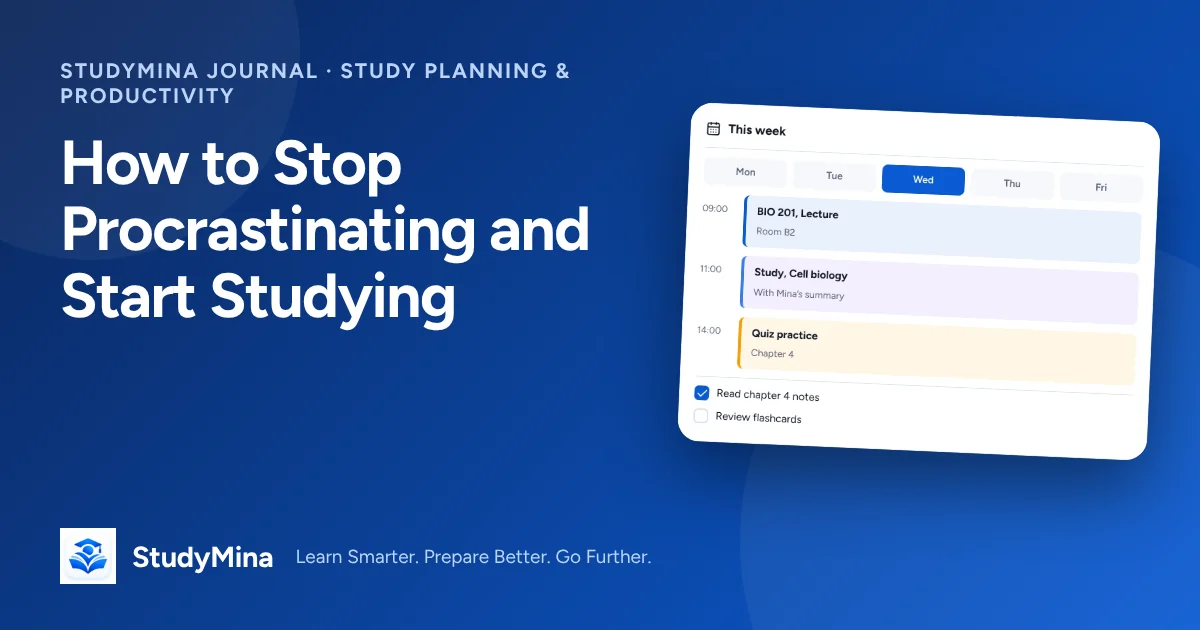
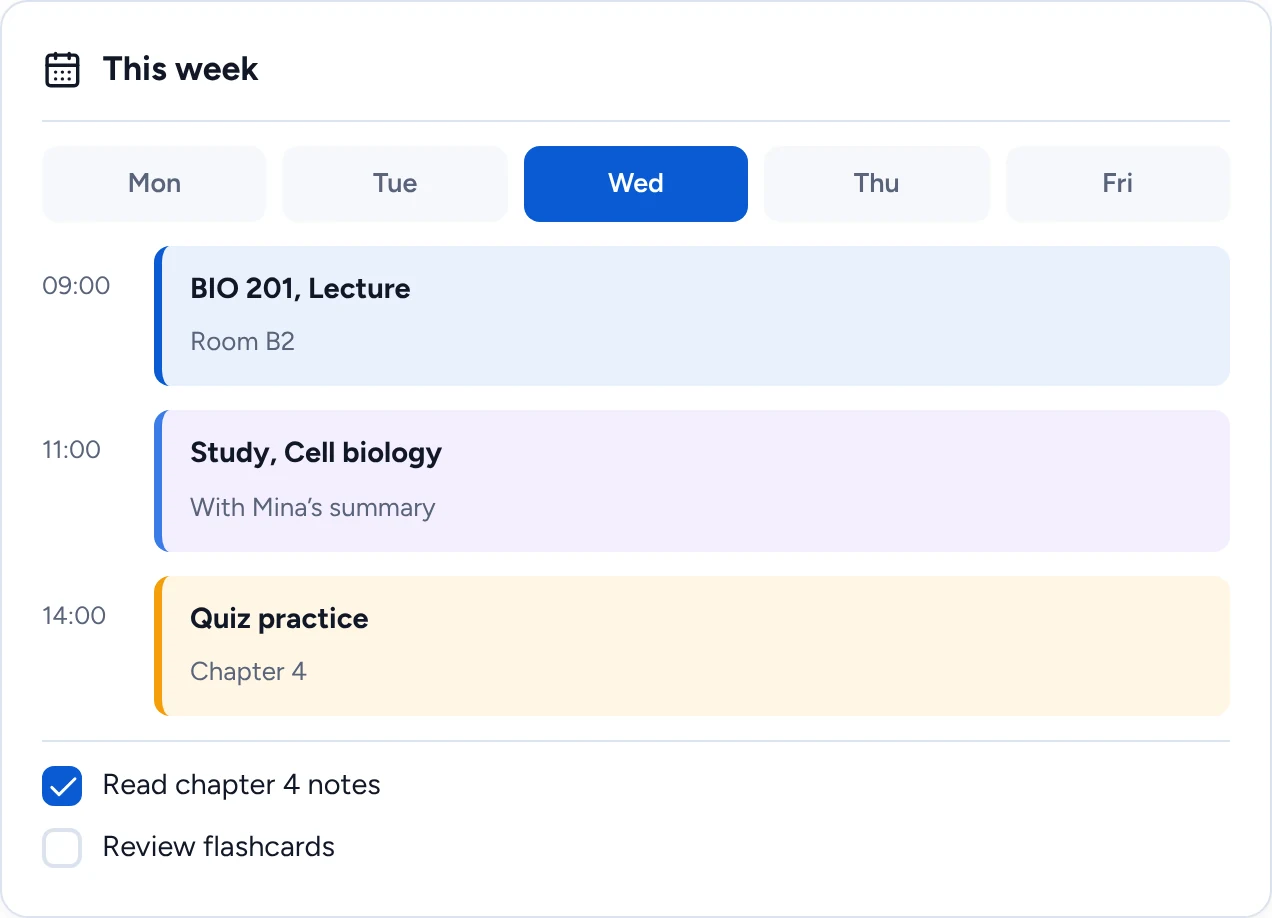
Plan tomorrow’s first task tonight in StudyMina’s planner, keep a short checklist of small steps, and open a quiz or flashcards for a five-minute start. Small, planned beginnings are what beat avoidance.
Sources
- Steel, P. (2007). The nature of procrastination: A meta-analytic and theoretical review of quintessential self-regulatory failure. Psychological Bulletin, 133(1), 65–94. doi.org/10.1037/0033-2909.133.1.65
- Gollwitzer, P. M. (1999). Implementation intentions: Strong effects of simple plans. American Psychologist, 54(7), 493–503. doi.org/10.1037/0003-066X.54.7.493